
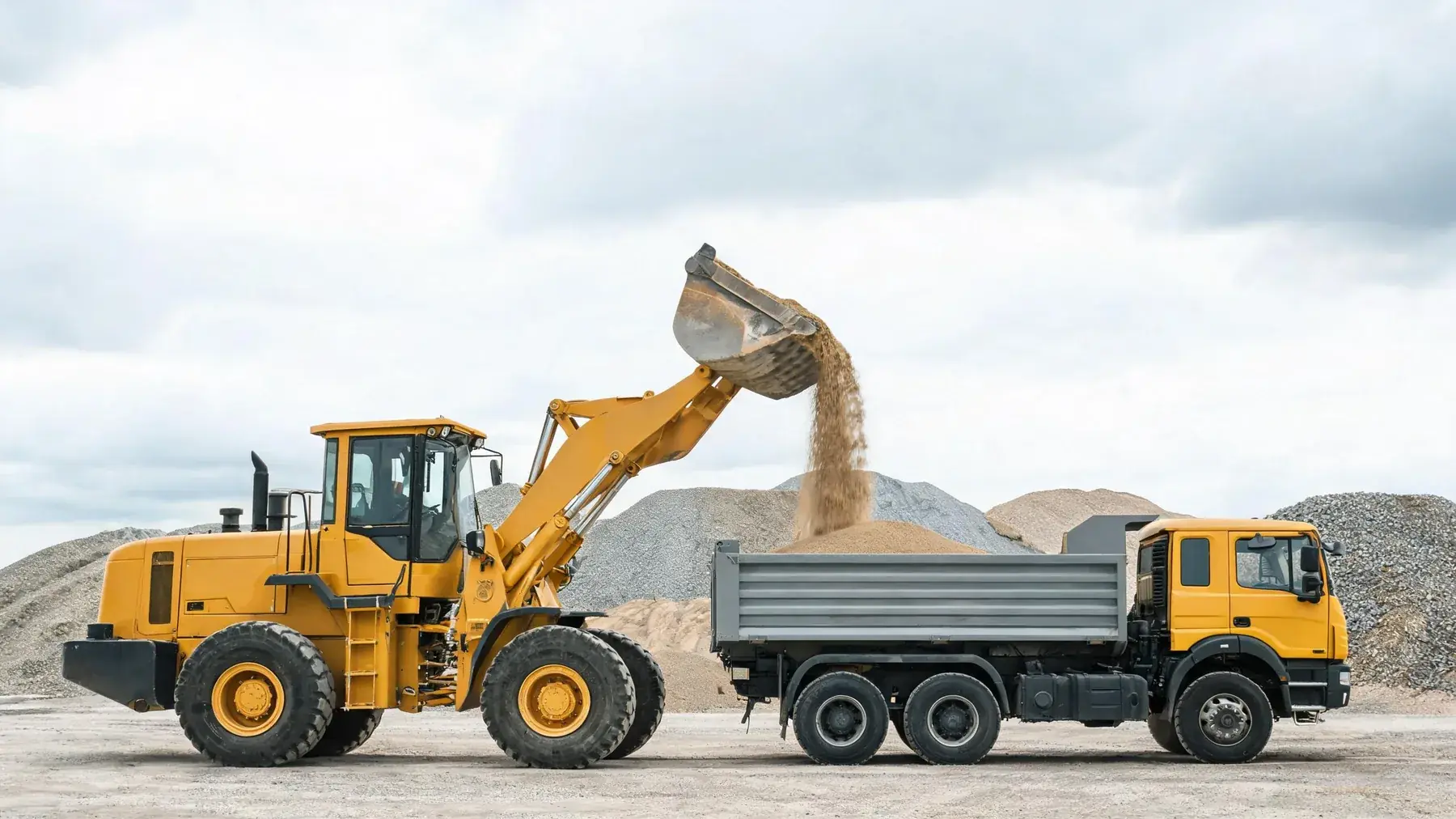
Wheel Loader Maintenance Checklist for African Job Sites
Dust, heat and long supply lines change the maintenance schedule. Here is a field checklist built around what actually fails on loaders in Africa.
A wheel loader that is serviced on the book schedule in a European depot will fail early on a dusty site with 45 °C afternoons and a parts supply line measured in weeks. The machine is not fragile — the schedule is simply written for a different environment.
This checklist is based on the failure pattern we see in export markets: air filtration, hydraulic contamination, cooling system, pins and bushes, and tyre damage.
Every shift
- Check engine oil, coolant and hydraulic oil level before start — not after.
- Drain water and sediment from the fuel pre-filter; on sites with poor fuel, do it twice a day.
- Walk around: look for oil weeping at cylinders, hoses and the transmission sump.
- Check tyre pressure and look for cuts, embedded stone and sidewall damage.
- Listen for turbo whine, brake noise and abnormal transmission shift.
- Clean the radiator and oil cooler fins with compressed air — not water — at the end of the shift.
First 50 hours
- Change engine oil and filter after the first 50 hours on a new or rebuilt engine.
- Check and re-torque wheel nuts.
- Inspect all hydraulic connections for weeping.
- Grease every point on the linkage and articulation joint.
- Check battery terminals and alternator output.
Every 250 hours
| System | Action |
|---|---|
| Engine | Oil and filter, fuel filter, air filter element inspection |
| Transmission | Oil level, filter, strainer screen; check for clutch pack debris |
| Hydraulics | Return filter, breather, cylinder rod inspection |
| Axles | Oil level, breather, differential seepage |
| Brakes | Pedal travel, accumulator pressure, wet disc wear indicator |
| Linkage | Grease all pins, check bush wear and bucket cutting edge |
| Tyres | Pressure, tread depth, sidewall cuts, rim condition |
At 500 hours add hydraulic oil sampling, transmission oil change, axle oil change and a full structural inspection of the boom and frame welds.
Living with dust
Dust is the single biggest cause of premature engine wear in dry markets. Three changes make a measurable difference:
- Pre-cleaner. Fit a cyclone pre-cleaner ahead of the main air filter and empty it daily. It removes 70–80% of the dust before it reaches the element.
- Filter inspection, not replacement by calendar. Check the restriction indicator; replace when it triggers, and never clean a paper element with compressed air from the inside.
- Cooling pack cleaning. Dust plus oil mist blocks the radiator and raises coolant temperature, which accelerates cylinder liner wear. Blow out the fins every shift in dry season.
Also check the cab filter — a blocked recirculation filter puts the operator in a dust cloud and increases fatigue-related errors.
The on-site spare parts kit
If the nearest dealer is a week away, keep a fast-moving kit on site:
- Engine oil, hydraulic oil and coolant in sealed drums
- Engine oil filter, fuel filter, hydraulic return filter, transmission filter
- Air filter primary and safety elements
- Two hydraulic hoses in the most common sizes, with fittings
- Bucket teeth and retaining pins
- Wheel nuts, studs and a torque wrench
- Fan belt, alternator belt and a spare battery
- Grease cartridges and a hand pump
This kit covers roughly 80% of unplanned stops. We can supply it as a single pre-packed box with the machine.
Storage and rainy season
Machines parked for weeks in humid conditions corrode internally. Before storage: wash the machine, fill the fuel tank to reduce condensation, change the engine oil, grease all points, disconnect and trickle-charge the battery, and park on timber with the bucket lowered. Cover the exhaust and air intake.
Run the machine for 30 minutes every two weeks if possible, and cycle the hydraulic functions to keep seals lubricated.
Need a service schedule for a specific model? Tell us the model and site conditions and we will send the matching maintenance table.
Quick answers
Sample at 500 hours and change at 1,000–1,500 hours depending on results. In very dusty conditions with poor filtration, change at 1,000 hours and inspect the suction strainer each time.
Only if the filtration rating and bypass pressure match the original. Cheap filters with the wrong micron rating cause more wear than they save. We supply genuine Sanyou filters and can quote a bulk pack.
Related models
Need this sized for your site?
Send the material, truck size and destination port. We will recommend the model and configuration in writing.